
Most small businesses buy marketing in pieces: a website from one person, ads from another and a follow-up tool that nobody has time to set up. Each piece may be fine on its own, but the leads fall through the gaps between them. This case study shows how website, ads and automation work together to produce more leads for a Frisco practice, and how you can apply the same thinking to your business.
The practice is Millennium Smiles, a Frisco dental practice I work with through Nomira Digital. I will describe what was built and what we track. I am not publishing result numbers here, because those belong to the practice and I prefer not to inflate them. The goal is to show the method clearly enough that you can judge it yourself.
The problem: leads leaking between tools
A familiar pattern shows up in many local businesses. Ads send people to a general homepage with a dozen choices. The contact form emails a single person who may not check it until the afternoon. Nobody can say which ad or page produced an inquiry, so decisions about budget are guesses.

The fix is not more traffic. It is a connected path from the first click to the first reply, with every step measured.
Layer one: a fast website with focused landing pages
We began with the website. It needed to load quickly on a phone, explain services in plain language and make the next step obvious. Then we added separate landing pages for each ad offer, one for new patient exams and one for dental emergencies. Each page has a single goal, a simple form and a visible phone number, and it removes the main menu so visitors are not tempted to wander.
Pages like these also load faster because they carry less content, which helps both visitors and ad quality scores. The reasoning is simple. A person who clicks an ad about a broken tooth wants help now. Sending that person to a page about cosmetic dentistry wastes the click. You can read more about the website layer in the website and AI automation case study for Frisco dental practices.
Layer two: ads that match the offer
The ads point to those landing pages. Targeting focuses on Frisco and the surrounding area, and each ad mentions the specific offer the page delivers. Consistency matters: the headline in the ad, the headline on the page and the first text message a lead receives should all say the same thing. That consistency builds trust and improves the chance that a visitor completes the form.
Keep in mind that healthcare advertising has its own platform rules and privacy considerations. Ad platforms limit how health-related audiences can be targeted, and tracking on patient pages needs care, which I cover in the guide to HIPAA-safe websites and automation.
Layer three: automation that answers first
When a form is submitted, the landing page sends the lead into GoHighLevel. The system saves the contact with its source, texts a confirmation, emails the details and alerts the front desk. A missed call can trigger a text or a callback. If nobody has responded after a set time, a reminder task appears.
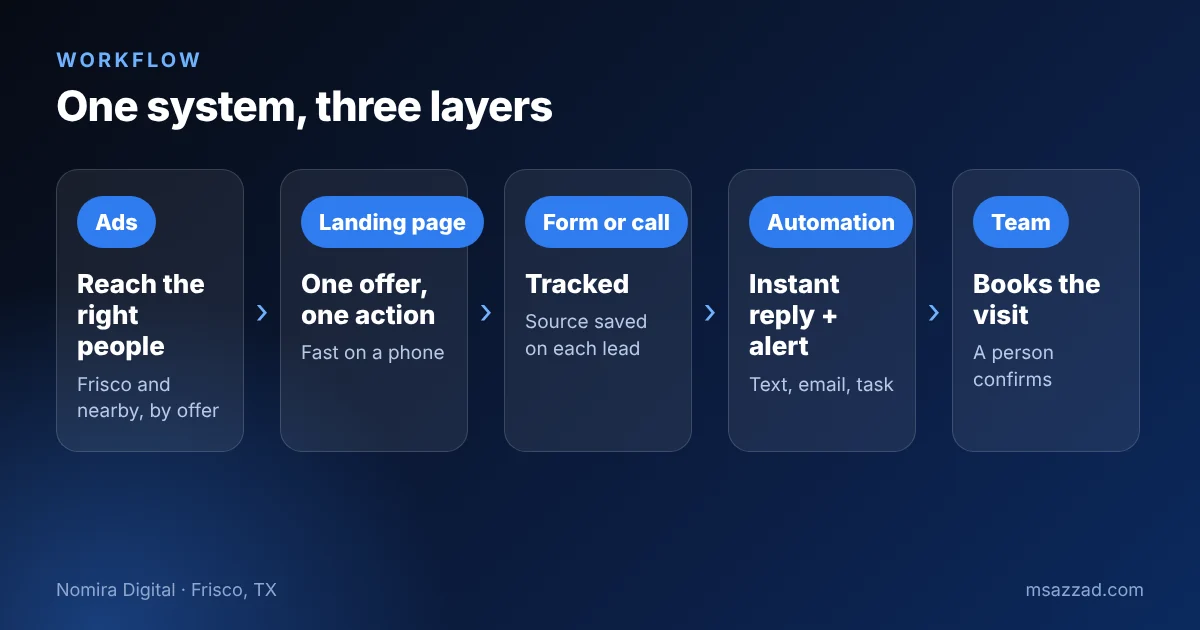
Speed is the reason this layer matters. Harvard Business Review researchers who studied 2,241 U.S. companies found that firms contacting a web lead within an hour were roughly seven times as likely to qualify it as firms that waited just one more hour. You can see the study abstract here. Ads pay for the click, but only a fast reply turns the click into a conversation.
What we track and why
A connected system is also a measurable one. Because each lead keeps its source, the practice can compare offers, pages and ad groups using the same list of numbers every month.

Two habits make the numbers useful. First, tag every lead with its source the moment it arrives, because a source added later is usually a guess. Second, review the same report on the same day each month. A consistent report beats a clever dashboard that nobody opens. When the practice sees that one offer brings many calls but few bookings, or that one page converts twice as well as another, it can move budget with confidence instead of instinct.
The most useful number is often the simplest: time to first reply. If it is measured in seconds, the system is working. If it is measured in hours, no amount of ad spend will fix the problem.

What we are still improving
A good case study also admits what is unfinished. Our callback assistant for missed calls is still being tested, and we are refining the wording of the follow-up messages to sound more natural. We are also working on review requests after visits, so the practice builds trust with the many Frisco families who read reviews before choosing a dentist.
The process is deliberately slow and steady. We change one thing at a time, wait long enough to see an effect and keep notes on what changed. That discipline matters more than any single tool. It prevents the common problem where a business changes the ad, the page and the message in the same week and then cannot tell what helped.
If your own marketing feels scattered, you can run a simple test this week. Submit your own contact form from your phone, time how long it takes to get a reply and count how many steps a stranger needs to complete before they reach you. Those two measurements alone often reveal the most important fix.
Lessons you can use in your business
- Give every ad offer its own landing page with one clear action.
- Send every form, call and chat into one place, with the source attached.
- Reply automatically within a minute, then follow up with a person.
- Review the same few numbers every month and change one thing at a time.
- Keep privacy and platform rules in mind from the start, especially in healthcare.
None of this requires a huge budget. It requires a clear path and the discipline to measure it. If you are in Frisco or elsewhere in DFW and want a connected website, ads and follow-up system, see our website development in Frisco, TX or contact me to talk it through.