
Sooner or later every Frisco business owner who plans a website hears the same advice from two directions. One person says "just use WordPress". Another says "get something custom". Both can be right, and both can be wrong for your situation. This guide compares WordPress vs a custom website for Frisco businesses in plain English, so you can pick the option that fits your goals, your team and your budget.
What each option means
WordPress is a content management system: software that lets you add and edit pages through a dashboard. You choose a theme for the design, add plugins for features such as forms or booking, and publish. It is flexible and widely supported.
A custom website is built by a developer with code written specifically for your business. There is no heavy theme or stack of plugins. Pages can be hand-coded, or built on a lighter framework, and the developer decides every detail of design and function.
The line is not always sharp. A WordPress site can be heavily customized, and a custom site can include an admin panel for editing text. The real question is how much of the work is pre-made and how much is built for you.
How popular is WordPress?
Very. According to W3Techs, WordPress was used by 39.6% of all websites on October 24, 2026, and by 58.3% of the sites whose content management system is known.
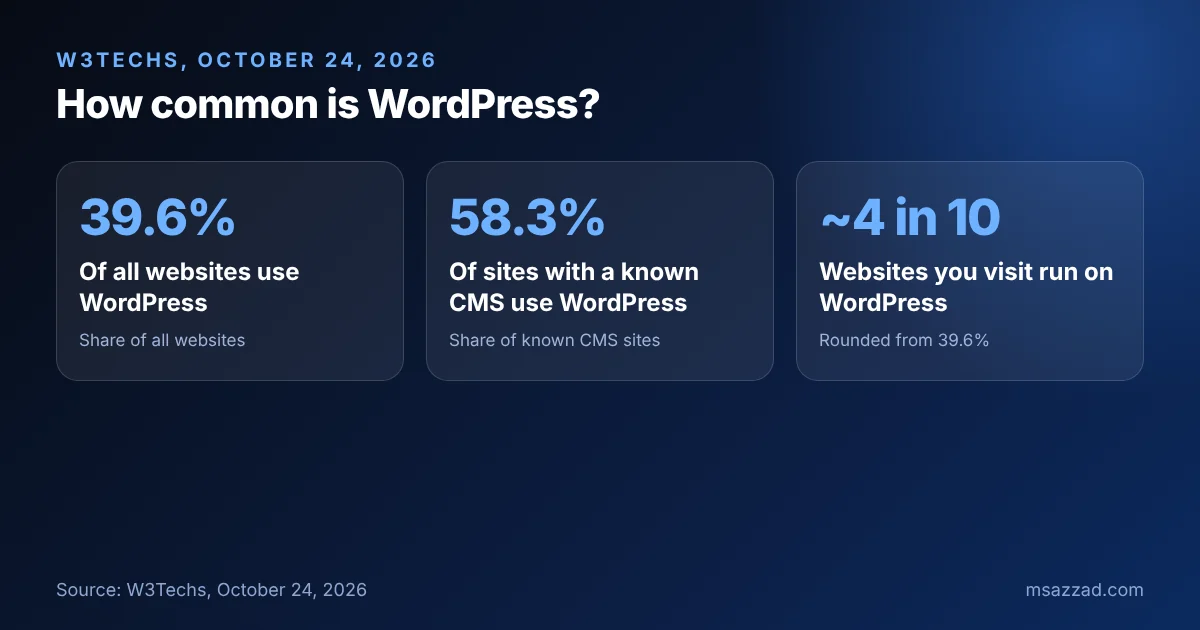
That popularity matters for a local business. It means thousands of developers, many tutorials and plenty of ready-made features. It also means attackers target it, so updates and backups are not optional.
WordPress versus custom: side by side
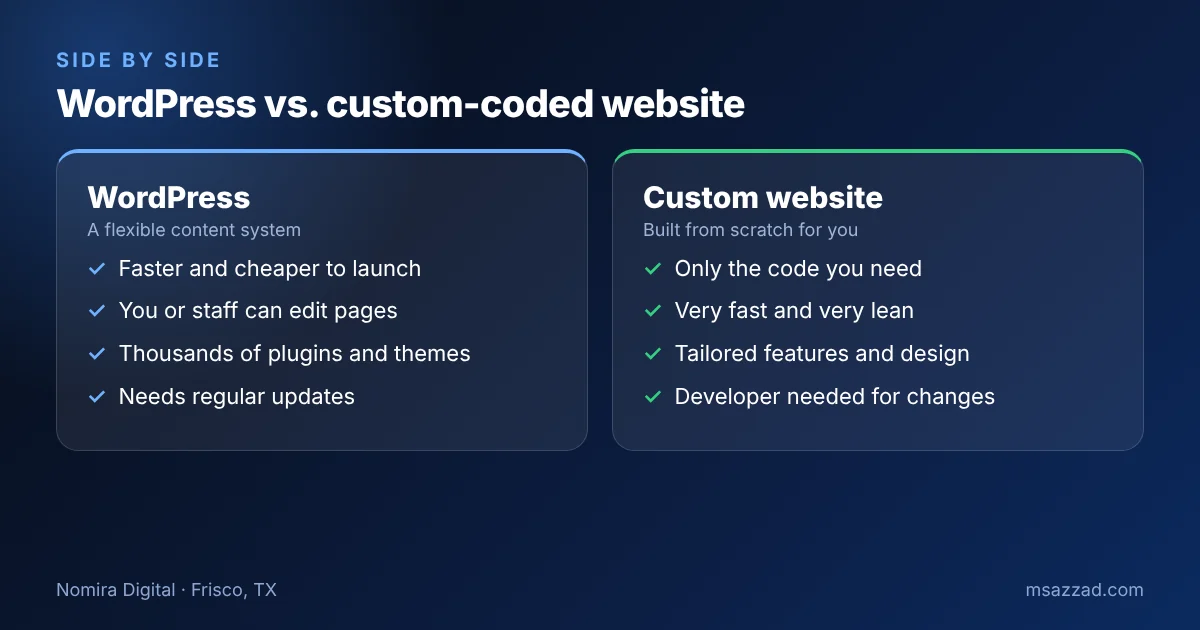
Cost and time. WordPress is usually faster and cheaper to launch because the building blocks already exist. A custom site takes more development time at the start, so it often costs more up front. See my website cost guide for Frisco, TX for typical ranges.
Speed. Speed is the area where the platform choice matters most. Many WordPress sites become slow because of large themes, page builders and stacks of plugins. A well-built WordPress site can be fast, but it takes discipline. A custom site loads only what each page needs, so it is fast by default.
SEO and AI search. Either can rank well. Search engines care about speed, clear content, structure and trust, not the platform. WordPress has helpful SEO plugins, while a custom site gives you full control over the code and structured data. For AI search tips, read the GEO and AEO guide for Frisco businesses.
Editing. If your staff will update pages, services or blog posts often, WordPress is hard to beat. With a custom site, changes usually go through the developer unless an editing panel is built in.
Security. A custom site with little code and no plugins has a smaller attack surface. WordPress can be secure, but only if the core, themes and plugins are kept up to date and you use strong passwords and backups.
Features. Common features such as forms, galleries or a simple shop are easy on WordPress. Unusual features, such as a custom quote calculator, a patient portal or a special booking flow, are often cleaner to build custom.
What each option needs after launch
Launch day is the easy part. A WordPress site needs regular updates to the core software, the theme and every plugin, plus daily or weekly backups and uptime monitoring. If nobody owns that routine, the site slowly gets less secure and less reliable. Budget a small monthly maintenance plan, or assign the job to a named person.
A custom site needs less routine upkeep because there are fewer moving parts, but it depends on a developer for changes. Make sure you have the source code, the hosting login and a short written note on how the site is deployed. If your developer disappears, another professional should be able to take over in a day, not a month.
In both cases, ask where the site is hosted, how quickly it loads from Texas and how restores work. Hosting near your audience, with a current PHP version and a caching layer, makes a bigger difference to speed than most people expect.
It is also worth asking about growth. A site that starts with five pages may need fifty in two years, with service area pages, blog posts and landing pages for ads. WordPress handles that kind of content growth naturally. A custom site can too, but only if it was designed with templates and a clear content structure from the start. Tell your developer your plans for the next two years, even if they are rough, so the foundation is not rebuilt too soon.
A custom example
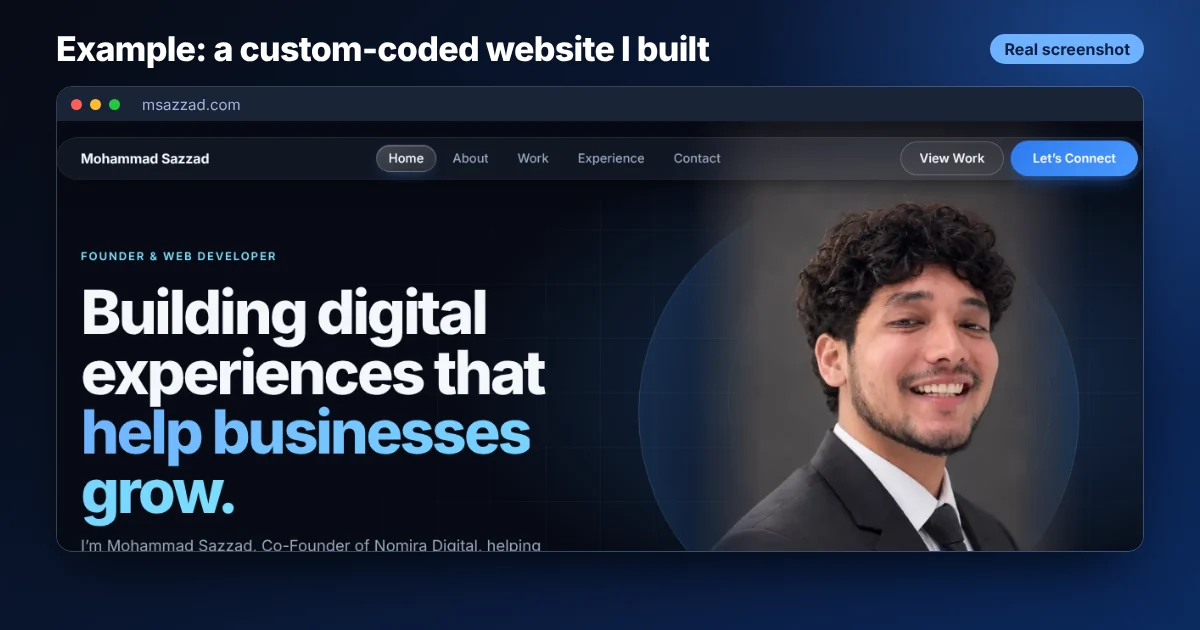
My own portfolio is a custom-coded site with no page builder. It loads very little code, and I can control every part of its structure. That is a good fit for me because I am a developer and I rarely change the text. A business that updates content every week would likely be happier with WordPress.
How to decide
Instead of asking which platform is better, ask these five questions:
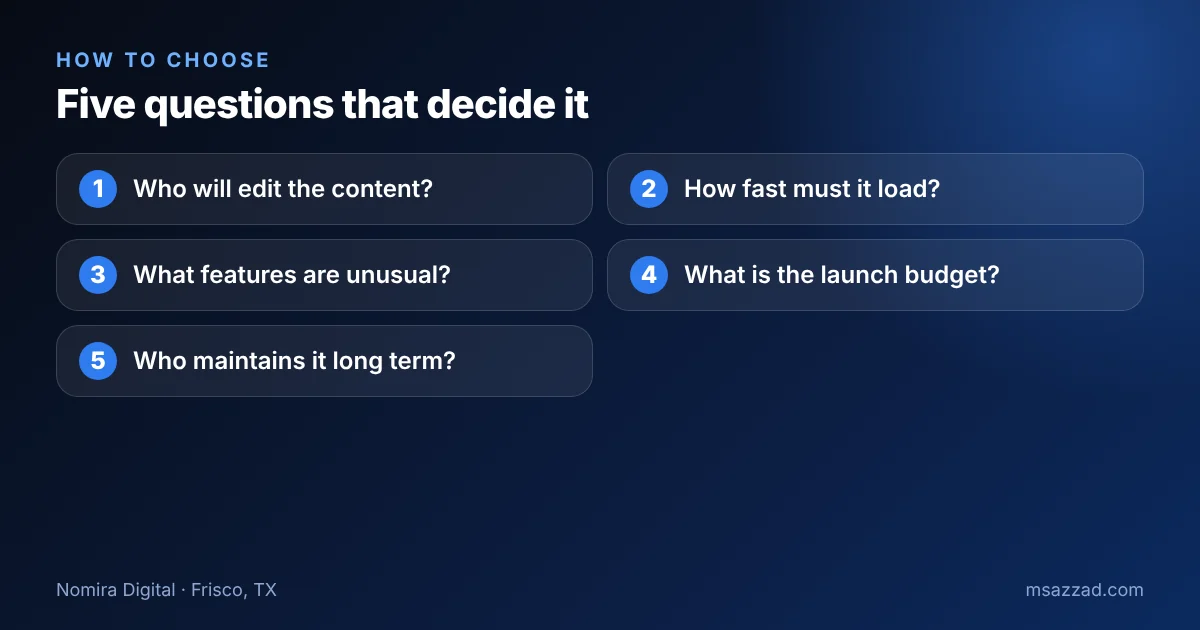
For most small Frisco businesses with simple needs and staff who want to edit content, a clean, lean WordPress build is a sensible choice. For businesses that need top speed, unusual features or tight control over data, such as healthcare practices or growing service companies, custom development is often worth the extra investment. Many of my projects are a mix: WordPress for the content, with custom code for the parts that matter.
One last point on cost: neither option is automatically cheaper over five years. WordPress is often cheaper in year one and similar by year three, once you include maintenance, premium plugins and speed work. A custom site often costs more in year one and then stays steady. Compare the total over a few years, not just the launch invoice, and include your own time, because a site that you cannot update yourself has a cost too.
Next steps
I build both kinds of sites at Nomira Digital, so I have no reason to push you toward one. Tell me what you need your site to do, who will edit it and what you want to spend, and I will recommend the simplest option that works. Explore our web design in Frisco, TX or contact me for honest advice.