
A few years ago, a person in Frisco who needed a dentist, a roofer or a realtor typed a search into Google and clicked a link. Today many of them ask ChatGPT, Gemini or Google's AI summary and read a single answer. If your business is not part of that answer, you can be invisible even when your website ranks well. This guide explains how Frisco businesses can show up in AI search, using plain words and steps you can start this month.
What GEO and AEO mean
AEO stands for answer engine optimization. It means writing and structuring your pages so a search tool can lift a clear, correct answer from them. GEO stands for generative engine optimization. It means making your business easy for AI systems that write their own answers, such as ChatGPT and Google's AI Overviews, to understand, trust and cite.
You do not need to abandon traditional SEO. The two overlap heavily. A fast, clear, well-organized site with accurate local details helps in both worlds. What changes is the goal: instead of only trying to earn a click, you also try to become the source an AI assistant names.

Why this matters for DFW businesses now
Two pieces of research show why. Gartner predicted in February 2024 that traditional search engine volume would drop 25% by 2026 as people turn to AI chatbots and virtual agents, according to its press release. That is a forecast, not a measurement, but it shows where analysts think behavior is heading.
The Pew Research Center measured real behavior. In its March 2025 analysis of the browsing of 900 U.S. adults, people clicked a result link on 8% of visits when Google showed an AI summary, compared with 15% when it did not. Only 1% clicked a link inside the summary.

For a local business in Frisco, the lesson is simple. Some answers will be read and never clicked, so your name, services and location need to appear inside those answers.
Step 1: Let AI tools read your site
Start with access. Check your robots.txt file and make sure you are not blocking the crawlers that AI assistants use. Make sure your pages load without needing a login, and that important text is real text on the page, not baked into an image. Fast mobile loading helps both people and crawlers. If your site is built with heavy scripts that hide text until a browser runs them, ask your developer to confirm that the main content is visible in the raw page source, because many crawlers do not run scripts the way a browser does.
Step 2: Write clear answers to real questions
AI tools pick up pages that answer a question directly. Think about what a new resident would ask: "Do you take my insurance?", "How much does a roof repair cost?", "Are you open on Saturdays?" Put each question in a heading, answer it in one or two short sentences and then add detail below. Add a frequently asked questions section to your service pages, and use the same wording customers use.
Here is what the difference looks like. A weak page says, "We offer a wide range of premium solutions tailored to your needs." A strong page says, "We repair and replace residential roofs in Collin County, Texas. Most repairs are quoted within one business day, and we offer free inspections after hailstorms." The second version contains facts a tool can quote: what you do, where you do it and how fast you respond. Vague marketing language gives an AI nothing to repeat.
Use short paragraphs, descriptive headings and simple lists for steps or requirements. Put the most important fact first, then explain. If a page mixes five topics, split it into five pages, each answering one question well.
Step 3: Add structured data and consistent details
Structured data, often called schema, is a small block of code that tells machines who you are: your business name, address, phone number, services and hours. It does not change how the page looks, but it removes guesswork for search tools. Equally important is consistency. Your name, address and phone number should match on your website, Google Business Profile and directories. If they differ, an AI tool may not be sure which version is right.
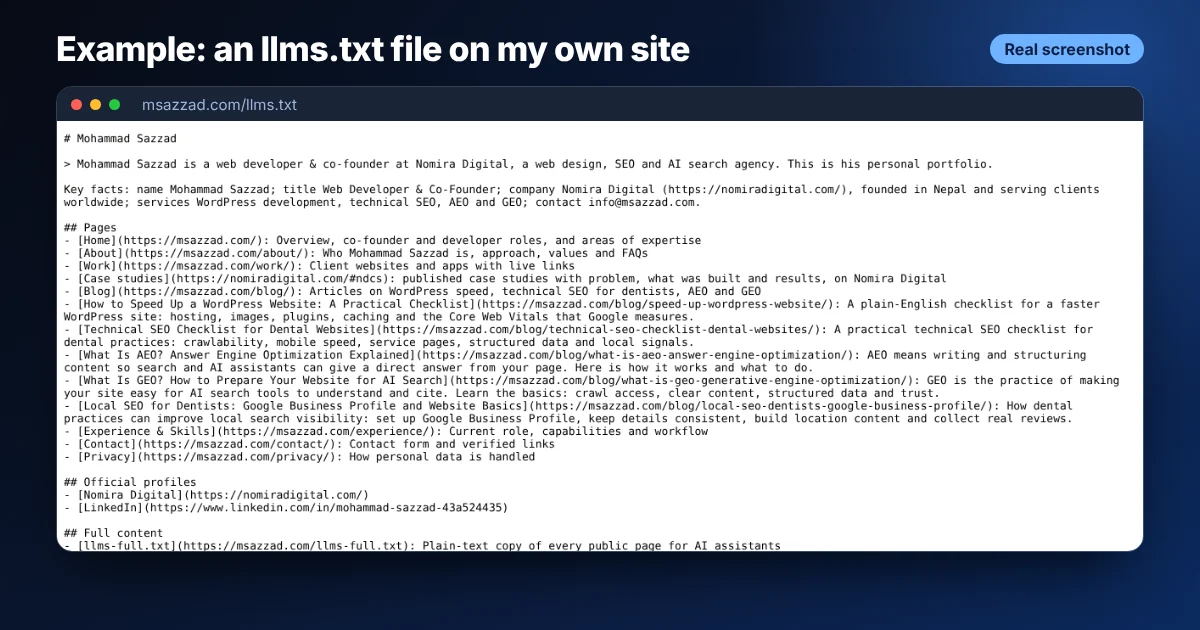
Many sites also publish an llms.txt file, a short text summary written for AI assistants. It is not a magic switch and no major platform has promised to use it, but it costs little and clarifies your offer. Here is the one on my own site:
Step 4: Build real trust signals
AI systems lean on sources that look trustworthy. Real reviews on Google, mentions on local sites, a clear About page with a real person's name and honest claims all help. Avoid exaggerated promises, because they weaken trust with people and machines alike. If you are a healthcare practice, add the provider's credentials and keep medical statements careful and accurate.
A checklist to start this month
Here is the short version, in the order I would tackle it for a local business in the DFW area:

Nobody can guarantee a citation from ChatGPT or Google, and anyone who promises one is guessing. What you can do is remove the obstacles and give AI tools clean, accurate material to work with. Then test: ask the assistants questions about your category and city, and note whether your business appears.
A simple monthly test works well. Write down five questions a customer might ask, such as "best family dentist near Frisco" or "who fixes roofs after hail in Collin County". Ask each one in ChatGPT, Gemini and Google, then record which businesses are named and which sources are linked. After a few months you will see whether your changes are moving the needle, and you will also learn which competitors the assistants prefer and why.
I build search-ready and AI-ready websites for businesses in Frisco and across Texas through Nomira Digital. See our web design service in Frisco, TX, read how a site fits into the bigger picture in the website cost guide for Frisco, TX, or contact me for a quick review of how your business shows up today.